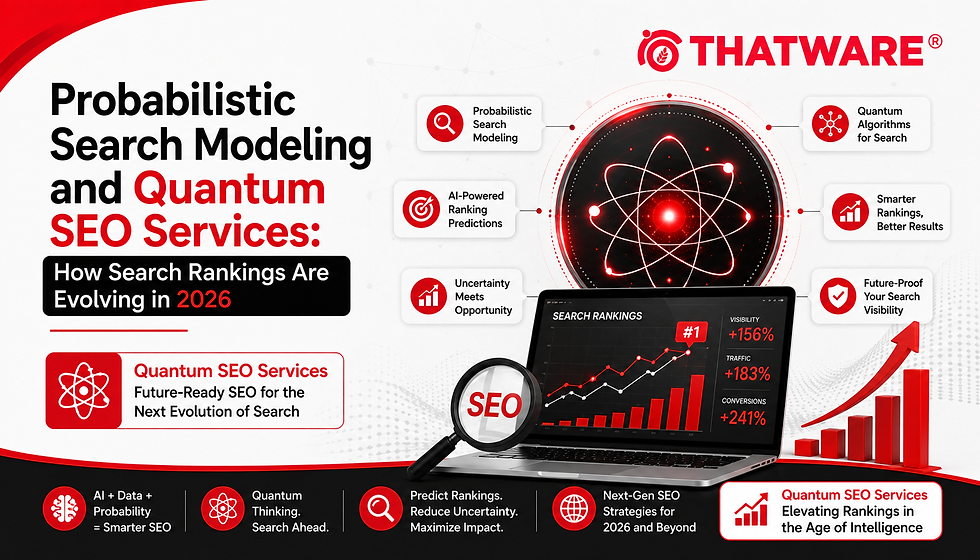
Probabilistic Search Modeling and Quantum SEO Services: How Search Rankings Are Evolving in 2026

Search engines are becoming increasingly sophisticated at understanding intent, context, relationships, uncertainty, and user behavior. In 2026, ranking is no longer simply about matching a keyword to a webpage. Modern search systems increasingly evaluate how useful, trustworthy, relevant, and contextually appropriate a result is for a particular query.
This shift makes Probabilistic Search Modeling an important concept for businesses, publishers, and SEO professionals to understand. Instead of treating rankings as a fixed formula, probabilistic systems can evaluate multiple signals and estimate which content is most likely to satisfy a user's needs. At the same time, emerging approaches associated with Quantum SEO Services are encouraging marketers to think beyond conventional keyword targeting and toward more advanced, interconnected search strategies.
For brands seeking sustainable organic visibility, understanding these changes can provide a significant strategic advantage.
Understanding Probabilistic Search Modeling
Probabilistic Search Modeling refers to an approach in which search systems use probabilities and multiple signals to estimate the relevance or usefulness of content for a particular search. Traditional SEO often encourages marketers to think in relatively straightforward terms: identify a keyword, create a page around it, optimize the title, build links, and monitor rankings. Modern search is considerably more dynamic.
A search engine may consider query meaning, previous interactions, content quality, topical relationships, freshness, location, device context, entity relationships, and many other signals before determining which results deserve visibility.
The result is that two people searching for similar terms may not always receive exactly the same ranking experience.
This is particularly important for businesses because ranking success increasingly depends on demonstrating genuine topical relevance rather than repeatedly inserting an exact-match keyword into a page.
Why Search Rankings Are Becoming More Dynamic
Search engines process enormous volumes of information every day. Google, for example, has described its systems as using numerous ranking systems and signals to determine which results are most helpful for users.
Probabilistic approaches fit naturally into this environment because they allow systems to evaluate uncertainty and competing possibilities.
Imagine someone searches for “best digital marketing strategy for ecommerce.” The search engine does not necessarily need to find a page containing that exact phrase dozens of times. Instead, it can interpret the underlying intent and identify pages covering ecommerce growth, conversion optimization, customer acquisition, technical SEO, content strategy, and related subjects.
This means businesses should increasingly build content ecosystems rather than isolated keyword pages. A strong website can establish relevance by publishing connected resources that answer different questions around a central subject. Over time, these relationships help search engines understand the site's expertise and topical coverage.
The Growing Connection Between AI and SEO
Artificial intelligence is another major factor influencing modern search.
AI-driven systems can process language at a deeper level than simple keyword matching. They can identify relationships between concepts, understand semantic meaning, interpret conversational queries, and evaluate information across different contexts.
This development makes Probabilistic Search Modeling particularly relevant to modern SEO. When search systems can estimate what users are trying to accomplish, businesses must optimize for intent as well as terminology.
For example, a page targeting “technical SEO services” may also need to address website crawling, indexing, Core Web Vitals, structured data, JavaScript rendering, internal linking, and site architecture. These supporting concepts help establish comprehensive topical relevance.
This is where Quantum SEO Services can represent a forward-looking SEO philosophy. Rather than focusing exclusively on individual ranking factors, the approach emphasizes interconnected data, experimentation, semantic relationships, automation, and continuous optimization.
The objective is to create a search presence capable of adapting as algorithms and user behavior evolve.
How Quantum SEO Services Can Support Modern Strategies
The term Quantum SEO Services is increasingly useful as a way to describe advanced SEO methodologies that move beyond conventional optimization workflows.
Rather than treating SEO as a checklist, an advanced strategy can examine the relationships between technical performance, content quality, search intent, entities, backlinks, user experience, and conversion behavior.
For example, a business launching a new service could analyze its market from several connected perspectives. Keyword research could reveal what potential customers search for. Competitor analysis could reveal content gaps. Entity research could identify related concepts. Technical analysis could uncover indexing opportunities. Content analysis could determine which questions remain unanswered.
These insights can then be combined into a coordinated SEO strategy.
That approach is especially valuable when working within an environment influenced by Probabilistic Search Modeling, because search visibility can depend on a broad collection of contextual signals rather than a single optimization factor.
What Businesses Should Change in Their SEO Strategy
The changing search environment does not mean traditional SEO is obsolete. Instead, it means foundational SEO should be combined with deeper strategic thinking.
Content should be written primarily for users while making its subject matter clear to search engines. Pages should provide original information, demonstrate expertise, answer relevant questions, and connect naturally with other resources on the website.
Internal linking is also becoming increasingly important because it helps users navigate related information while providing search engines with additional context about relationships between pages.
Businesses should also monitor more than keyword rankings. Organic traffic quality, engagement, conversions, indexed pages, visibility across relevant queries, and assisted conversions can provide a broader picture of SEO performance.
A practical modern workflow can involve researching user intent, developing topical clusters, improving technical accessibility, strengthening content depth, building authoritative references, measuring performance, and continuously refining the strategy based on real-world results.
Building Content for Probabilistic Search Environments
One of the most effective ways to prepare for modern search is to create comprehensive content around topics rather than producing dozens of disconnected pages.
Suppose a company wants to rank for “enterprise SEO.” A single service page may introduce the offering, but supporting resources could cover enterprise technical SEO, international SEO, JavaScript SEO, enterprise content strategy, SEO forecasting, migration planning, and measurement.
Each resource serves a specific search intent while contributing to the broader topic.
This structure gives a website multiple opportunities to demonstrate expertise and helps establish meaningful relationships between concepts.
It also creates a better experience for visitors because readers can move from introductory information to detailed resources without leaving the website.
For businesses exploring advanced strategies, the discussion around Probabilistic Search Modeling and Quantum SEO Services provides an opportunity to rethink how content, technical SEO, authority, and user intent work together.
The Future of SEO Is More Contextual
Search optimization in 2026 is increasingly about context.
A page can have excellent keyword placement and still struggle to perform if it fails to satisfy the user's underlying intent. Conversely, a highly useful resource can become visible for a wide range of relevant searches because it comprehensively addresses a subject.
This makes quality, relevance, expertise, and information architecture essential components of long-term SEO.
Businesses should therefore avoid chasing every algorithm update individually. A more sustainable approach is to build websites that are technically accessible, useful to audiences, easy to understand, logically connected, and supported by credible information.
That foundation can remain valuable even as individual ranking systems change.
Final Thoughts
The evolution of search is creating a more sophisticated environment for digital marketers. Probabilistic Search Modeling highlights how ranking systems can evaluate multiple signals and estimate relevance rather than relying on simple keyword matching. Meanwhile, Quantum SEO Services reflects the growing demand for interconnected, data-informed, adaptive approaches to search optimization.
For businesses, the opportunity is clear: focus on user intent, develop comprehensive topical authority, strengthen technical foundations, connect related content, and continuously measure outcomes.
If you want to explore how Probabilistic Search Modeling is influencing modern rankings and what these changes could mean for your SEO strategy, visit the detailed resource from ThatWare LLP. The future of SEO belongs to strategies that understand not only what people search for, but also why they search, what information they need, and how different signals work together to deliver meaningful results.
#ProbabilisticSearchModeling #QuantumSEOServices #SEO2026 #AISEO #SearchEngineOptimization #SearchRankings #SemanticSEO #DigitalMarketing


Comments