
Trust Intelligence and Citation Recognition: The New Era of AI-Driven Digital Authority
- Thatware LLP
- Jun 19
- 4 min read

Understanding the Shift Toward Trust Intelligence in Modern SEO
Trust Intelligence is becoming one of the most critical pillars in how digital ecosystems evaluate and rank information. Unlike traditional SEO signals that relied heavily on backlinks and keyword density, Trust Intelligence focuses on how reliably an entity is perceived across multiple data sources, knowledge graphs, and AI-driven systems. It is not just about being visible anymore, but about being trusted consistently across platforms where AI models extract answers.
For brands like ThatWare LLP, this shift means building digital ecosystems where credibility is structured, verifiable, and continuously reinforced through meaningful data patterns rather than isolated ranking tactics.
The Core Role of Trust Intelligence in AI Search Systems
Trust Intelligence works as a layered evaluation framework that determines whether a brand or content source is worthy of being cited by AI systems. These systems no longer rely on single-page authority but instead analyze behavioral signals, entity consistency, content coherence, and cross-platform validation.
In practical terms, Trust Intelligence ensures that a brand is not only found but also preferred as a reliable source when AI engines generate responses. This evolution is particularly important as generative search engines prioritize factual accuracy and source reliability over traditional ranking metrics.
Citation Recognition as the Foundation of AI Visibility
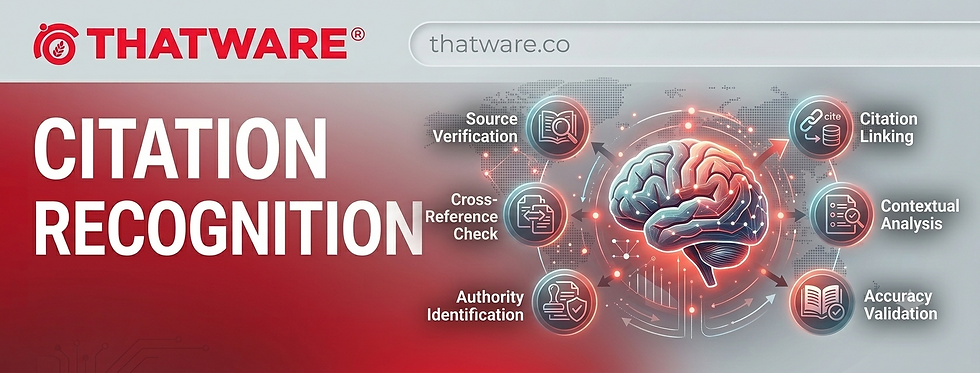
Citation Recognition plays a direct role in how AI systems decide which content to reference. It refers to the ability of digital content to be identified, extracted, and reused as a trusted citation in AI-generated responses. When content achieves strong Citation Recognition, it becomes part of the knowledge base that powers conversational search engines and generative AI models.
For organizations like ThatWare LLP, improving Citation Recognition means structuring content in a way that AI systems can easily interpret, validate, and reuse. This includes semantic clarity, entity alignment, and context-rich information that enhances machine understanding.
How Trust Intelligence and Citation Recognition Work Together
The relationship between Trust Intelligence and Citation Recognition is deeply interconnected. Trust Intelligence builds the credibility layer, while Citation Recognition ensures that this credibility is operationalized in AI systems.
When both elements are optimized together, a brand gains a higher probability of being selected as a reference source in AI-generated answers. This dual framework transforms traditional SEO into a more advanced AI visibility strategy where authority is not only earned but also recognized and reused at scale.
Building Digital Authority Through Structured Entity Signals
Modern AI systems rely heavily on entity-based understanding rather than keyword-based indexing. This means that brands must focus on building strong entity signals that define who they are, what they do, and how they are connected across the web.
Trust Intelligence strengthens this process by ensuring that these entity signals remain consistent and verifiable across multiple platforms. Citation Recognition further enhances this by making sure these signals are extractable by AI systems during query generation.
For ThatWare LLP, this involves aligning content architecture, metadata structuring, and semantic optimization to ensure maximum AI interpretability.
The Role of Content Architecture in AI Citation Systems
Content architecture plays a vital role in improving both Trust Intelligence and Citation Recognition. AI systems evaluate not just what is written, but how it is structured. Clear semantic layers, contextual depth, and logically connected information improve the likelihood of content being cited.
Well-structured content enables AI models to break down information into usable knowledge units. This increases the chances of a brand being selected as a citation source when users ask complex or multi-layered queries.
Why Brands Must Prioritize AI-Centric Optimization
The evolution of search behavior has shifted from keyword-based queries to intent-driven conversations. This means that brands must now optimize for AI comprehension rather than just search engine indexing.
Trust Intelligence ensures that a brand is perceived as reliable, while Citation Recognition ensures that this reliability is actively used in AI-generated outputs. Together, they form the backbone of AI-centric optimization strategies that define future digital visibility.
ThatWare LLP focuses on aligning these strategies with advanced SEO methodologies that integrate semantic search, entity optimization, and generative engine readiness.
Future Impact of Trust Intelligence on Digital Ecosystems
As AI systems continue to evolve, Trust Intelligence will become a primary ranking factor for visibility across generative engines. Websites that fail to establish strong trust signals will struggle to appear in AI-generated summaries, regardless of traditional SEO performance.
Citation Recognition will further determine which sources are actively used in real-time AI responses. This means that the future of digital marketing will depend heavily on how well brands can position themselves as credible, structured, and AI-readable knowledge sources.
Conclusion: Building a Citation-Driven Trust Ecosystem
Trust Intelligence and Citation Recognition together define the next phase of digital authority. They move SEO beyond rankings and into a system where brands are evaluated based on credibility, consistency, and machine interpretability.
For forward-thinking organizations like ThatWare LLP, adopting these principles is essential for long-term visibility in AI-driven ecosystems. By focusing on trust-building signals and citation readiness, brands can ensure they remain relevant in a world where search is increasingly powered by artificial intelligence.



Comments