
AI-Driven Digital Marketing Strategies That Help Businesses Build Sustainable Online Growth

Discover how AI-driven digital marketing, SEO, content, and data strategies can improve visibility, qualified traffic, conversions, and long-term business growth.
In today’s competitive digital landscape, businesses need more than occasional social media posts or conventional advertising to stay visible. Thatware LLP represents the kind of modern digital marketing approach where technology, search intelligence, content strategy, and measurable performance work together to create sustainable growth. Agency Vista positions itself as a marketplace where businesses can discover and evaluate marketing agencies based on services, experience, performance, and other criteria.
This article explores a broader and more practical approach to digital growth: how businesses can combine SEO, content, AI, data, and conversion optimization into one connected marketing ecosystem.
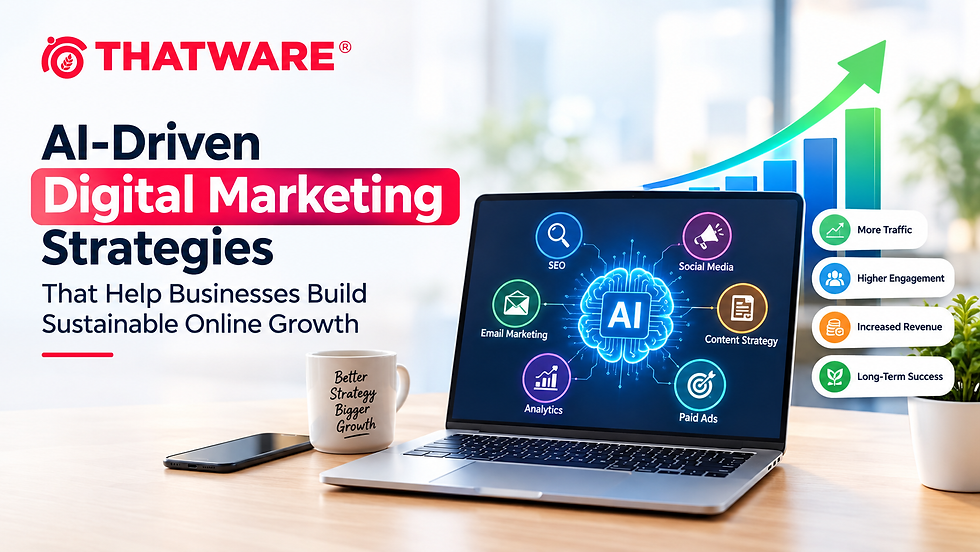
Why Modern Digital Marketing Needs a Smarter Approach
Digital marketing has changed significantly. Search engines increasingly understand context, entities, user intent, and relationships between topics rather than relying only on exact-match keywords.
At the same time, customers may discover a business through traditional search results, AI-generated answers, social platforms, directories, reviews, or branded content.
This makes a fragmented marketing strategy less effective.
A stronger approach connects:
AI-powered SEO strategy, content marketing, technical optimization, authority building, conversion optimization, and performance measurement.
The objective is not simply to generate website traffic. It is to attract the right audience and help that audience move from discovery to consideration and eventually to conversion.
Five Emerging SEO Keywords Businesses Should Prioritize
The following concepts represent valuable opportunities for businesses developing an advanced organic-growth strategy:
AI search optimization
Generative engine optimization
Answer engine optimization
Semantic SEO strategy
Entity-based SEO
These keywords can be incorporated naturally into service pages, educational resources, supporting articles, FAQs, and knowledge hubs without creating repetitive or unnatural copy.
How AI Is Changing the SEO Strategy
Artificial intelligence is influencing how people search, compare brands, discover information, and make purchase decisions.
A traditional SEO strategy might focus heavily on ranking a page for a particular keyword. An AI-focused strategy considers a broader question:
Can search engines and AI systems understand the business, its expertise, its products, and its relationship to a specific topic?
That distinction matters.
From Keywords to Search Intent
Instead of producing multiple pages targeting minor keyword variations, businesses can build comprehensive topic clusters around genuine customer questions.
For example, a company offering digital marketing could develop connected resources covering:
SEO strategy
technical SEO
content optimization
AI search visibility
conversion optimization
local search
analytics
This creates stronger topical relationships and gives both users and search systems more useful context.
From Rankings to Search Visibility
A first-page ranking remains valuable, but modern visibility extends beyond traditional blue links.
Businesses should also consider how their brand appears across:
AI-generated answers
featured snippets
knowledge panels
local results
industry directories
review platforms
social channels
This broader perspective makes generative engine optimization increasingly relevant to businesses that want to remain discoverable as search behavior evolves.
SEO, AEO, GEO, and Traditional Marketing: What's the Difference?
Strategy | Primary Focus | Main Opportunity |
Traditional SEO | Search engine rankings | Organic website traffic |
AI Search Optimization | AI-assisted discovery | Better visibility in AI-driven search |
AEO | Direct answers | Visibility for question-based searches |
GEO | Generative search experiences | Brand mentions and AI citations |
Content Marketing | Information and education | Authority and audience engagement |
Conversion Optimization | User actions | More leads and sales |
These approaches should not necessarily replace one another. Instead, they can operate together as parts of a unified digital marketing system.
Building a Strong Semantic SEO Strategy
A successful semantic SEO strategy focuses on relationships between concepts rather than isolated keywords.
Suppose a website targets the subject of ecommerce marketing. A semantically rich content ecosystem could cover product discovery, category optimization, technical SEO, structured data, user experience, product descriptions, internal linking, customer reviews, and conversion optimization.
Each supporting topic strengthens the overall context.
Create Topic Clusters
Start with a core topic and identify the questions and subtopics users are likely to explore.
Then create:
A comprehensive pillar page.
Supporting educational articles.
Relevant service pages.
FAQ content.
Case studies and examples.
Internal links connecting closely related subjects.
This structure helps establish topical depth while giving visitors logical pathways through the website.
Why Entity-Based SEO Matters
Search engines increasingly need to understand who a business is, what it offers, where it operates, and which topics it has genuine expertise in.
This is where entity-based SEO becomes useful.
Businesses can strengthen their entity signals by maintaining consistency across:
Business profiles.
Author information.
About pages.
Service descriptions.
Industry directories.
Social profiles.
Third-party mentions.
Reviews.
Structured data.
The goal is to create a consistent digital identity rather than disconnected pieces of information scattered across the web.
Content Should Be Built for Humans First
AI can accelerate research, analysis, and content workflows, but useful content still needs human value.
High-performing content should demonstrate:
Experience
Explain practical observations, examples, processes, and lessons that readers can actually use.
Expertise
Cover the subject accurately and provide meaningful depth instead of repeating generic information.
Originality
Offer a distinctive viewpoint, useful comparisons, proprietary insights, or practical frameworks.
Clarity
Avoid unnecessary jargon. A technically advanced topic can still be easy to understand.
Actionability
Give readers a clear next step after they finish reading.
This approach supports both user experience and sustainable organic visibility.
Connecting SEO With Conversion Optimization
Traffic alone does not create business growth.
A website can attract thousands of visitors and still generate poor commercial results if its pages lack compelling calls to action, clear value propositions, trust signals, or intuitive navigation.
A stronger strategy connects SEO with conversion optimization from the beginning.
For example:
Search visibility → Relevant visitor → Helpful content → Trust → Action → Lead or sale
Every stage should be measurable.
Useful metrics can include organic impressions, qualified clicks, engagement, assisted conversions, lead quality, conversion rate, customer acquisition cost, and revenue generated from organic channels.
How Businesses Can Build a Future-Ready SEO Framework
A practical framework can be organized into five connected stages.
Discover
Research the market, audience, competitors, search behavior, customer questions, and existing website performance.
Structure
Build clear website architecture, topic clusters, internal linking, structured data, and logical information hierarchy.
Optimize
Improve technical SEO, content quality, user experience, metadata, page performance, and search intent alignment.
Establish Authority
Develop original resources, digital PR, relevant backlinks, expert contributions, reviews, and credible third-party mentions.
Measure and Improve
Use analytics and search data to identify what is producing meaningful business outcomes and continuously refine the strategy.
Why Brand Authority Is Becoming More Important
As search becomes more conversational, brand recognition can influence whether users trust and select a company.
A brand that consistently publishes useful information, receives credible mentions, maintains accurate business information, and demonstrates expertise can create stronger digital signals than a website that focuses solely on keyword placement.
That makes reputation, expertise, consistency, and useful content important parts of modern AI search optimization.
Conclusion
The future of digital marketing is not about choosing between SEO, AI, content, or conversion optimization. It is about connecting these disciplines into a coherent strategy.
Businesses that invest in AI search optimization, generative engine optimization, answer engine optimization, semantic SEO strategy, and entity-based SEO can build a stronger foundation for changing search environments.
The most sustainable approach is simple: understand the audience, create genuinely useful resources, establish topical and brand authority, make the website technically accessible, and measure outcomes that matter to the business.
With an AI-aware and data-driven approach, Thatware LLP can be positioned naturally within a broader digital marketing ecosystem focused on visibility, relevance, authority, and measurable growth.
Frequently Asked Questions
What is AI search optimization?
AI search optimization is the process of improving a brand's digital presence so that its information can be better understood and surfaced within AI-powered search and answer experiences. It goes beyond traditional keyword targeting by considering context, entities, authority, content structure, and user intent.
How is GEO different from traditional SEO?
Traditional SEO primarily focuses on improving visibility in search engine results. Generative Engine Optimization focuses more broadly on visibility within generative search experiences, including how brands and information may be represented in AI-generated responses.
Does AEO replace SEO?
No. Answer Engine Optimization complements traditional SEO. SEO can help a website become discoverable, while AEO focuses on structuring useful information so that it can better satisfy direct, question-oriented searches.
How can businesses improve their visibility in AI-generated answers?
Businesses can start by publishing authoritative, original, well-structured content; maintaining consistent business and author information; developing strong topical coverage; earning credible mentions; implementing appropriate structured data; and directly answering relevant customer questions.
For businesses evaluating marketing partners, platforms such as Agency Vista provide agency discovery and comparison features, including information about services, performance, reviews, and agency profiles.


Comments