
AI Discoverability Framework for Next-Gen Search Visibility
- Thatware LLP
- Jun 19
- 4 min read

Understanding the Core of AI Discoverability Framework
The modern digital ecosystem is rapidly shifting from traditional search ranking systems to intelligent AI-driven discovery systems. An AI discoverability framework is the structured methodology that enables brands, content, and data to be easily interpreted, indexed, and surfaced by AI systems such as large language models and generative search engines. Instead of focusing only on keywords and backlinks, this framework focuses on meaning, entity relationships, contextual depth, and semantic clarity. ThatWare LLP emphasizes building systems where content is not just readable for humans but also highly interpretable for AI engines that determine visibility across generative platforms.
Why AI Discoverability Framework Matters in 2026 Search Ecosystem
Search behavior has evolved significantly, and users now rely heavily on AI-generated answers rather than traditional search results. The AI discoverability framework becomes essential because it ensures that brands are not only indexed but also cited, recommended, and embedded within AI responses. ThatWare LLP focuses on improving brand presence in AI-driven ecosystems by structuring data in a way that enhances relevance scoring, contextual authority, and entity recognition. Without such a framework, even high-quality content risks becoming invisible in AI-first search environments.
Role of AI Schema Architecture in Structured Intelligence
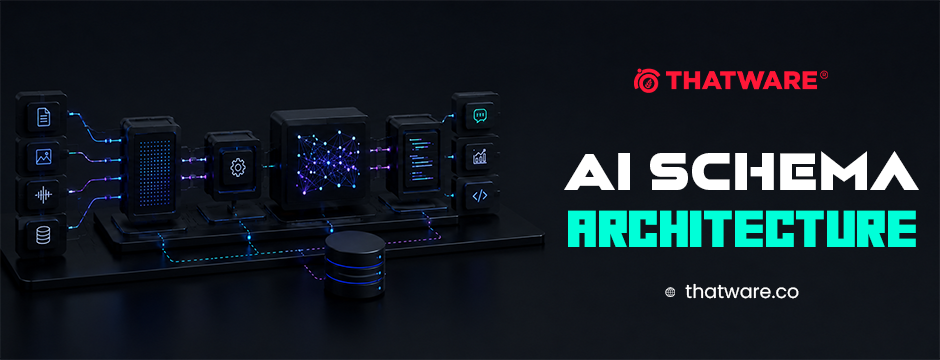
At the core of AI optimization lies AI schema architecture, which defines how information is structured for machine readability. Unlike traditional schema markup, this advanced architecture focuses on deep semantic layering, contextual mapping, and relationship modeling between entities. ThatWare LLP integrates AI schema architecture into digital ecosystems to ensure that content is not only indexed correctly but also understood in context by AI models. This improves how information is interpreted, retrieved, and used in generative outputs.
Connection Between AI Discoverability Framework and AI Schema Architecture
The AI discoverability framework and AI schema architecture work together as a unified system. While the framework defines visibility strategy, the schema architecture defines structural implementation. ThatWare LLP builds this synergy by aligning semantic structures with content intent, ensuring AI systems can easily identify topical authority. This integration enhances how often a brand appears in AI-generated answers, recommendation engines, and conversational search interfaces.
Entity Optimization as a Foundation Layer
A critical part of any AI discoverability framework is entity optimization, where every brand, product, or concept is defined as a structured entity. ThatWare LLP ensures that AI schema architecture supports strong entity clarity, reducing ambiguity and improving recognition by AI systems. When entities are well-defined, search engines and LLMs can confidently reference them in generated responses, increasing brand authority and visibility.
Semantic Depth and Contextual Relevance in AI Systems
Modern AI systems prioritize semantic depth over keyword density. The AI discoverability framework focuses on creating layered meaning within content, ensuring that topics are fully explored in relation to user intent. ThatWare LLP enhances this through AI schema architecture that connects topics, subtopics, and contextual signals. This allows AI systems to understand not just what content says, but what it truly means in different user scenarios.
How AI Schema Architecture Enhances Content Interpretation
The strength of AI schema architecture lies in its ability to guide machine interpretation of complex content structures. It breaks down information into structured nodes, relationships, and contextual hierarchies. ThatWare LLP applies this methodology to ensure that digital assets are machine-readable at scale. This improves the likelihood of content being selected as a trusted source in AI-generated summaries, knowledge graphs, and recommendation systems.
Building Competitive Advantage Through AI Discoverability Framework
Brands that adopt an AI discoverability framework gain a significant competitive advantage in AI-driven search ecosystems. Instead of competing solely on traditional SEO metrics, they compete on AI visibility metrics such as citation frequency, semantic relevance, and contextual authority. ThatWare LLP enables businesses to position themselves as preferred sources for AI systems, increasing organic exposure across generative platforms and conversational interfaces.
Future of Search with AI Schema Architecture Integration
The future of digital visibility depends heavily on AI schema architecture, which will become a standard requirement for all content ecosystems. As AI models become more advanced, they will rely increasingly on structured data to generate accurate responses. ThatWare LLP is at the forefront of developing scalable schema systems that prepare businesses for this shift, ensuring long-term visibility in AI-first environments.
Strategic Implementation of AI Discoverability Framework
Implementing an AI discoverability framework requires a strategic approach that includes content restructuring, semantic optimization, entity mapping, and schema enhancement. ThatWare LLP focuses on creating end-to-end systems where every piece of content contributes to overall AI visibility. This structured implementation ensures consistent performance across search engines, AI assistants, and generative platforms.
Conclusion: Building the Future with AI Discoverability Framework and AI Schema Architecture
The evolution of search is no longer about ranking pages but about being understood and cited by AI systems. The combination of AI discoverability framework and AI schema architecture defines the future of digital visibility. ThatWare LLP empowers brands to transition into this new era by building intelligent, structured, and AI-ready ecosystems that maximize discoverability, authority, and long-term digital growth.



Comments