Semantic Schema Architecture for AI-Driven Search Optimization and Machine Understanding

Search engines are no longer limited to keyword matching and backlink analysis. They are evolving into intelligent systems capable of understanding meaning, relationships, and context. In this transformation, semantic schema architecture plays a critical role in helping machines interpret content more accurately.
Modern SEO now depends on structured intelligence rather than plain text optimization. This is where concepts like AI search optimization schema, machine-readable AI schema, and schema for AI crawlers become essential. These frameworks help search engines and AI systems understand websites like structured knowledge graphs instead of unorganized text.
Businesses that adapt to this evolution gain stronger visibility, improved indexing accuracy, and better representation in AI-generated answers and search summaries. This blog explores how semantic schema systems work and why they are becoming the backbone of next-generation SEO strategies.
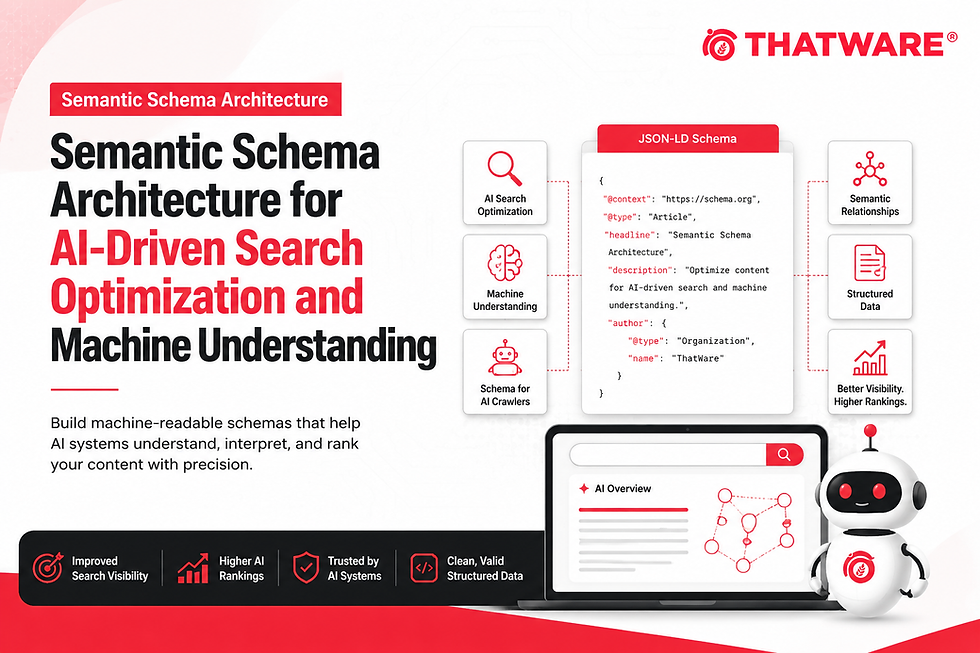
Understanding Semantic Schema Architecture in Modern SEO Systems
The concept of semantic schema architecture revolves around structuring website data in a way that machines can interpret relationships between entities, topics, and context. Unlike traditional HTML content, semantic schema creates meaning layers that AI systems can process directly.
For example, instead of simply displaying a product description, semantic structures define what the product is, how it relates to a category, and how users interact with it. This structured clarity helps search engines build a deeper understanding of content relevance.
In today’s AI-driven ecosystem, semantic schema is not optional. Studies indicate that structured data can significantly improve click-through rates and indexing efficiency, especially in AI-powered search environments. Google itself has confirmed that structured data helps systems better interpret page context, which directly influences search visibility.
When implemented correctly, semantic schema architecture enables websites to become part of knowledge graphs, allowing AI systems to connect entities across the web with higher precision.
The Role of AI Search Optimization Schema in Digital Visibility
The rise of generative search and AI-powered assistants has transformed how users receive information. Traditional ranking signals are now complemented by semantic understanding. This is where AI search optimization schema becomes a critical SEO asset.
This schema framework ensures that content is not just indexed but also interpreted correctly by AI systems. It provides structured signals about intent, meaning, and entity relationships, which are essential for AI-based search engines and large language models.
For instance, when a user searches for a service, AI systems rely on structured schema data to extract accurate answers rather than just listing links. Websites using advanced schema structures are more likely to appear in featured snippets, AI overviews, and conversational search results.
Businesses leveraging AI search optimization schema often experience improved organic reach because their content becomes machine-readable and semantically enriched. This allows search engines to trust and prioritize their content in dynamic search environments.
Machine-Readable AI Schema and Its Impact on Content Interpretation
The evolution of SEO is deeply tied to the development of machine-readable AI schema, which allows machines to interpret web content without ambiguity. Unlike traditional metadata, machine-readable schema defines explicit relationships between entities such as people, services, locations, and concepts.
This structured clarity ensures that AI systems can process content with minimal confusion. For example, instead of guessing whether “Apple” refers to a fruit or a company, schema markup defines it clearly for the machine.
A well-designed machine-readable AI schema improves:
Content indexing speed across search enginesEntity recognition accuracy in knowledge graphsRelevance scoring in AI-driven ranking systemsVisibility in semantic search results
In addition, machine-readable structures reduce misinterpretation and improve contextual accuracy. This is especially important in industries like healthcare, finance, and technology where precision is critical.
Organizations adopting this approach are better positioned for the future of AI-first indexing systems, where structured data plays a central role in ranking and retrieval.
Schema for AI Crawlers and Intelligent Indexing Systems
Search engine crawlers are becoming more intelligent, shifting from rule-based indexing to AI-powered interpretation. The schema for AI crawlers is designed specifically to support this transformation.
AI crawlers no longer rely solely on textual cues. Instead, they analyze structured schema data to understand the meaning, intent, and relationships within content. This allows them to categorize and rank content more effectively.
A strong schema for AI crawlers enables websites to:
Improve entity-based indexing in knowledge graphsEnhance content discoverability in semantic search enginesStrengthen topical authority signalsReduce indexing errors and misclassification
For example, websites using structured schemas are more likely to be featured in AI-generated summaries because crawlers can easily extract verified and structured information.
As AI search engines evolve, schema will act as the communication bridge between human-readable content and machine intelligence.
Strategic Implementation with ThatWare LLP’s AI Schema Framework
Implementing advanced schema systems requires technical expertise and a deep understanding of semantic SEO. That is where ThatWare LLP provides specialized solutions designed for AI-first indexing environments.
Through advanced frameworks such as semantic modeling, entity-based structuring, and knowledge graph integration, businesses can fully leverage semantic schema architecture to enhance their digital presence.
ThatWare LLP focuses on building scalable systems that integrate AI search optimization schema into websites, ensuring that every piece of content is structured for maximum machine readability. Their approach includes deep semantic mapping, structured entity tagging, and AI-driven optimization models.
By adopting these technologies, businesses can significantly improve their visibility across AI search platforms and future-proof their SEO strategy.
Conclusion: The Future of SEO Lies in Structured Intelligence
The future of search is no longer based solely on keywords but on meaning, structure, and machine interpretation. Concepts like semantic schema architecture, AI search optimization schema, machine-readable AI schema, and schema for AI crawlers are defining the next phase of digital visibility.
Websites that adopt these frameworks early will have a competitive advantage in AI-driven search ecosystems. Structured data is no longer just a technical enhancement; it is a strategic necessity for digital growth.
If your goal is to improve search visibility, enhance indexing accuracy, and align with AI-powered algorithms, investing in advanced schema systems is essential.
ThatWare LLP provides industry-leading expertise in building intelligent schema frameworks designed for the future of search.


Comments