Semantic Schema Architecture: Building AI-Ready Websites for the Future of Search

The search landscape is changing rapidly. Traditional search engine optimization is no longer enough for businesses that want to remain visible in an ecosystem increasingly influenced by artificial intelligence. Search engines, AI assistants, language models, and intelligent crawlers now rely on structured and machine-readable data to understand web content more accurately.
This shift has made semantic schema architecture one of the most important components of modern digital marketing. Businesses that implement advanced structured data frameworks gain a competitive advantage by helping AI systems interpret, categorize, and recommend their content more effectively.
As AI-powered search experiences continue to evolve, organizations need an advanced AI search optimization schema strategy that ensures their information can be understood not only by traditional search engines but also by emerging AI platforms.
Understanding Semantic Schema Architecture
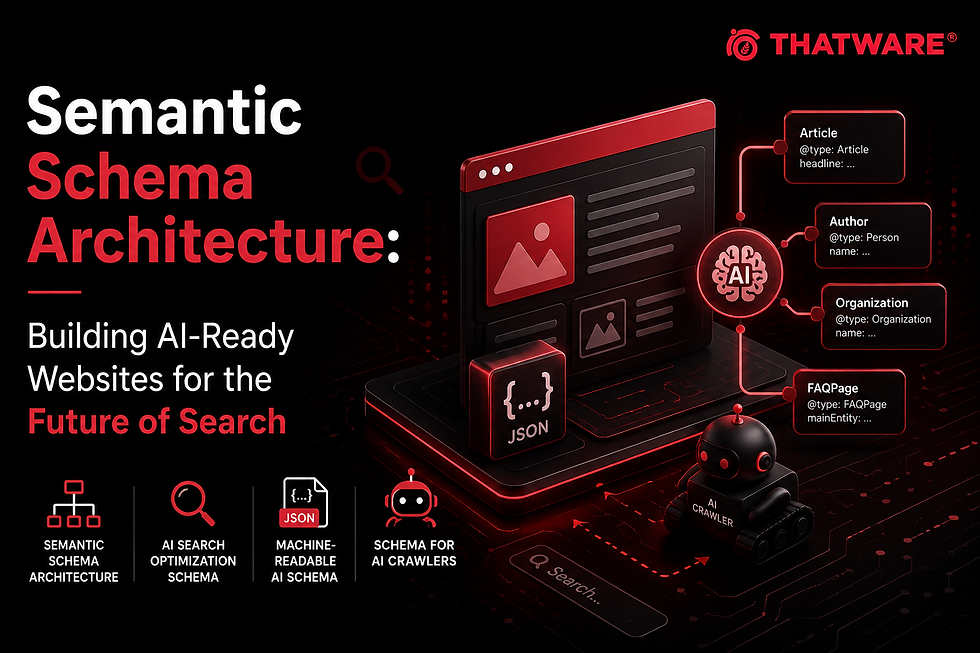
Semantic schema architecture refers to a structured framework that organizes website data in a way that machines can understand context, relationships, and meaning.
Unlike traditional metadata that focuses on isolated information, semantic architecture creates interconnected relationships between entities, concepts, services, products, and content. This allows AI systems to interpret information more intelligently.
When properly implemented, semantic schema architecture helps machines understand:
The purpose of a webpage.
The relationship between topics.
The authority of a business.
Connections between services and products.
Context behind user intent.
Modern AI systems increasingly rely on semantic relationships rather than simple keyword matching. This makes structured semantic frameworks essential for future-ready websites.
Why AI Search Engines Depend on Structured Data
Artificial intelligence models process vast amounts of information every day. However, they perform best when content is presented in a structured format.
A robust machine-readable AI schema helps AI platforms interpret data without ambiguity. Instead of guessing what a webpage represents, AI systems receive clear signals about content meaning and relevance.
Industry studies suggest that websites utilizing advanced structured data often experience improved indexing efficiency and stronger visibility across search ecosystems. While rankings depend on multiple factors, structured content significantly enhances discoverability.
As AI-driven search continues to expand, organizations are investing heavily in AI search optimization schema frameworks that support machine interpretation and knowledge extraction.
The Role of Machine-Readable AI Schema in Digital Visibility
A machine-readable AI schema acts as a communication layer between websites and intelligent systems.
Search engines traditionally relied on crawling and indexing content. Modern AI systems go further by analyzing relationships, contextual meaning, and entity connections.
Machine-readable AI schema helps by providing:
Clear content classification.
Entity identification.
Knowledge graph integration.
Content hierarchy mapping.
Contextual understanding.
These capabilities make websites more accessible to AI assistants, generative search engines, recommendation systems, and large language models.
Organizations that embrace machine-readable AI schema gain a stronger foundation for future AI-driven visibility.
Schema for AI Crawlers: The Next Evolution of SEO
Search engines are no longer the only systems crawling websites. AI models, virtual assistants, and intelligent discovery engines now analyze web content to generate answers and recommendations.
This evolution has increased demand for specialized schema for AI crawlers.
Schema for AI crawlers provides structured pathways that help machines understand:
Business information.
Service offerings.
Industry expertise.
Content relationships.
Topical authority.
Website intent.
Instead of relying solely on text interpretation, AI crawlers can leverage structured semantic signals to deliver more accurate responses.
As AI-generated search experiences become more common, schema for AI crawlers will become a critical component of technical SEO strategies.
How Semantic Schema Architecture Supports Generative AI Search
Generative AI search engines produce responses by synthesizing information from multiple sources. To be included in these responses, content must be trustworthy, understandable, and machine-readable.
This is where semantic schema architecture delivers substantial value.
A well-designed semantic framework allows AI systems to:
Identify authoritative entities.
Recognize topical expertise.
Understand service relationships.
Interpret content context.
Extract meaningful insights.
When combined with an advanced AI search optimization schema strategy, businesses improve their chances of becoming trusted sources within AI-generated answers.
This creates new opportunities for brand visibility beyond traditional search rankings.
Why Businesses Need AI Search Optimization Schema Today
The transition toward AI-powered search is already underway. Organizations that wait too long may struggle to compete against businesses investing in AI readiness today.
Implementing an effective AI search optimization schema offers several advantages.
It improves machine understanding of website content.
It enhances content discoverability across AI ecosystems.
It strengthens entity recognition.
It supports future indexing technologies.
It helps establish digital authority.
Businesses that prioritize AI search optimization schema are positioning themselves for long-term visibility in an increasingly intelligent search environment.
How ThatWare LLP Leads AI-Driven Schema Innovation
As one of the pioneers in AI-powered SEO solutions, ThatWare LLP focuses on helping businesses prepare for the future of search.
Through advanced semantic technologies, AI-driven optimization frameworks, and intelligent structured data solutions, ThatWare LLP develops customized strategies that align websites with modern AI requirements.
Their expertise in semantic schema architecture enables businesses to build stronger machine understanding while improving visibility across search engines and AI platforms.
Organizations seeking scalable AI optimization solutions can benefit from comprehensive implementation strategies designed specifically for evolving search technologies.
Conclusion
The future of search belongs to websites that machines can understand. As AI systems become more influential in content discovery, traditional optimization techniques must evolve.
Semantic schema architecture provides the foundation for this transformation by helping AI interpret meaning, context, and relationships more accurately. Combined with a strong machine-readable AI schema framework and specialized schema for AI crawlers, businesses can improve visibility across both current and emerging search environments.
Organizations that invest in AI search optimization schema today are preparing for the next generation of digital discovery. With expertise from ThatWare LLP, businesses can build intelligent, future-ready websites designed for success in the AI era.


Comments