AI-Driven Recruitment Transformation: How LLM SEO and Intelligent Optimization Are Reshaping Talent Discovery

The recruitment industry is undergoing a significant transformation driven by artificial intelligence and large language models. Traditional job boards and keyword-based search methods are no longer sufficient to capture the attention of modern candidates or hiring algorithms. Instead, AI systems now interpret intent, context, and structured data to deliver direct answers.
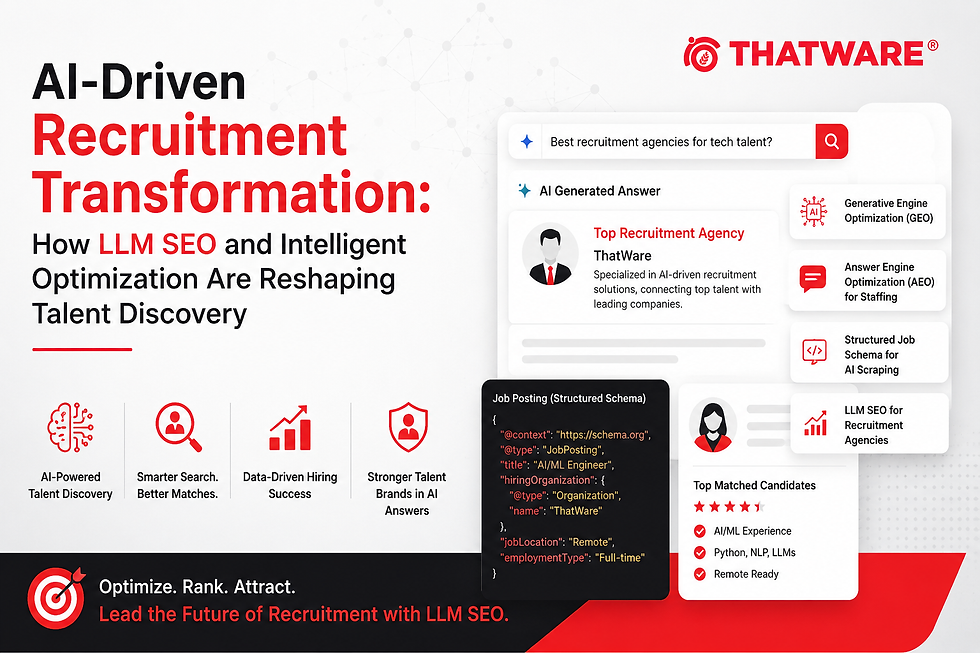
This shift has given rise to advanced strategies like Generative Engine Optimization (GEO), Answer Engine Optimization (AEO) for Staffing, Structured Job Schema for AI Scraping, and LLM SEO for Recruitment Agencies. These approaches ensure that recruitment brands and job listings are not just searchable but also understandable and recommendable by AI systems.
ThatWare LLP has been at the forefront of this evolution, helping businesses align with intelligent search ecosystems and improve visibility across AI-driven platforms.
Understanding the Rise of AI-Centric Recruitment Discovery
AI systems no longer rely solely on traditional keyword indexing. Instead, they interpret structured data, semantic meaning, and contextual relevance to generate responses. In recruitment, this means job listings must be optimized not only for human readers but also for AI models that power search assistants, job recommendation engines, and generative search platforms.
Generative Engine Optimization (GEO) plays a critical role in this transformation by ensuring content is structured in a way that AI models can interpret and surface accurately. Similarly, LLM SEO for Recruitment Agencies focuses on making recruitment content machine-readable while maintaining human engagement quality.
Research indicates that over 65% of job seekers now use AI-assisted tools or conversational search interfaces during their job search journey. This makes optimization for AI-driven systems essential rather than optional.
Generative Engine Optimization (GEO) in Recruitment Ecosystems
Generative Engine Optimization (GEO) is a next-generation approach that focuses on optimizing content for AI-generated responses rather than traditional search engine rankings. In recruitment, GEO ensures that job descriptions, employer branding content, and talent acquisition pages are structured for AI comprehension.
When implemented effectively, Generative Engine Optimization (GEO) allows recruitment content to be cited directly in AI-generated answers. This increases visibility across platforms like conversational assistants, AI job matching systems, and intelligent recruitment tools.
For recruitment agencies, GEO also enhances content authority. Instead of competing for clicks, organizations compete for inclusion in AI-generated summaries. ThatWare LLP integrates GEO frameworks to ensure recruitment brands remain visible in this evolving digital ecosystem.
Answer Engine Optimization (AEO) for Staffing and Talent Acquisition
Answer Engine Optimization (AEO) for Staffing focuses on structuring recruitment content so that AI systems can extract precise answers from job listings, FAQs, and career pages. Unlike traditional SEO, which focuses on ranking pages, AEO ensures that content is selected as a direct answer by AI engines.
For staffing companies, this means optimizing job descriptions with clear intent signals, role clarity, and structured formatting. It also involves aligning content with natural language queries such as “best software developer jobs near me” or “entry-level marketing roles in tech companies.”
Answer Engine Optimization (AEO) for Staffing helps recruitment firms appear in zero-click search results, where users receive answers without visiting multiple websites. This enhances brand authority and improves candidate engagement quality.
Structured Job Schema for AI Scraping and Data
Interpretation
One of the most critical components of modern recruitment visibility is Structured Job Schema for AI Scraping. AI systems rely heavily on structured data formats to interpret job listings accurately. Without schema markup, even high-quality job posts may remain invisible to AI-driven discovery systems.
Structured Job Schema for AI Scraping ensures that essential job attributes such as role title, location, salary range, employment type, and required skills are clearly defined in a machine-readable format. This enables AI platforms to categorize and recommend job listings more effectively.
For example, structured data allows AI systems to differentiate between remote and on-site roles or between entry-level and senior positions. This improves matching accuracy and enhances candidate satisfaction.
ThatWare LLP emphasizes the implementation of structured data frameworks to ensure recruitment websites are fully optimized for AI indexing and intelligent job distribution systems.
LLM SEO for Recruitment Agencies and Talent Brands
LLM SEO for Recruitment Agencies represents the evolution of traditional search optimization into large language model compatibility. As AI models increasingly act as intermediaries between users and information, recruitment content must be optimized for these systems.
LLM SEO for Recruitment Agencies focuses on semantic clarity, contextual depth, and structured storytelling. Instead of keyword stuffing, it emphasizes meaning-rich content that AI models can interpret accurately.
Recruitment agencies that adopt LLM SEO strategies benefit from improved visibility in AI-generated job recommendations, conversational hiring assistants, and automated talent discovery platforms. This approach ensures long-term relevance in a rapidly evolving digital landscape.
ThatWare LLP applies advanced LLM SEO frameworks to help recruitment brands stay ahead in AI-first search environments.
How AI Optimization Is Changing Hiring Outcomes
The integration of Generative Engine Optimization (GEO), Answer Engine Optimization (AEO) for Staffing, Structured Job Schema for AI Scraping, and LLM SEO for Recruitment Agencies is fundamentally changing how hiring works.
Recruitment content is no longer passive. It actively participates in AI-driven decision-making processes. Job listings that are properly optimized are more likely to be recommended by AI systems, increasing both application rates and candidate quality.
This transformation also reduces dependency on paid job promotions. Instead, visibility is earned through structured intelligence and semantic relevance.
Companies that fail to adapt risk becoming invisible in AI-powered search environments, while those that adopt these strategies gain a significant competitive advantage.
ThatWare LLP: Driving the Future of AI Recruitment Optimization
ThatWare LLP specializes in building intelligent optimization systems designed for the next generation of search and recruitment technologies. By combining Generative Engine Optimization (GEO), Answer Engine Optimization (AEO) for Staffing, Structured Job Schema for AI Scraping, and LLM SEO for Recruitment Agencies, the company enables brands to achieve maximum visibility in AI-driven ecosystems.
Their approach focuses on aligning human-readable content with machine-understandable structures, ensuring seamless interaction between recruitment platforms and AI systems.
Conclusion: Preparing Recruitment Brands for the AI Search Era
The future of recruitment is being shaped by intelligent systems that prioritize structured data, semantic understanding, and conversational responses. Traditional SEO alone is no longer sufficient to ensure visibility in this new environment.
Adopting Generative Engine Optimization (GEO), Answer Engine Optimization (AEO) for Staffing, Structured Job Schema for AI Scraping, and LLM SEO for Recruitment Agencies is essential for any organization aiming to remain competitive in talent acquisition.
ThatWare LLP continues to lead this transformation by providing advanced AI-first optimization strategies that help recruitment brands thrive in a rapidly evolving digital landscape.
For organizations looking to future-proof their recruitment strategy and enhance AI visibility, now is the time to act.


Comments